“Quiet peacefulness, absolute emptiness — the true qi follows.” Suwen 1
We need our emotions.
This may sound obvious, but in practice it is increasingly countercultural.
Much of contemporary wellness and pop psychology frames emotional health as the achievement of calm: regulation as smoothing, neutralizing, or quieting experience. The implicit goal is an unruffled state.
Yet from the perspective of classical Chinese medicine, this goal is not only unrealistic: it is physiologically misguided.
Why Suppression Distorts Rather than Resolves
In the classical view, emotions are not psychological noise layered on top of the body. They are movements of qi itself. They carry information about direction, alignment, and strain. Health depends not on eliminating these movements, but on having enough internal stability to register them accurately and respond appropriately.
The Huangdi Neijing Suwen makes this clear in its most foundational chapter:
“Quiet peacefulness, absolute emptiness — the true qi follows.” Suwen 1
This line is often misunderstood. It does not describe emotional numbness or dissociation. It describes a condition of sufficient inner spaciousness. It describes freedom from compulsive desire and chronic fear, such that qi can move according to its nature. Calm, in this sense, is not manufactured. It is an emergent property of coherence.
The Suwen is equally explicit that emotions themselves are physiological movements, each with a characteristic direction:
“Anger causes qi to rise. Joy causes qi to slacken. Sadness causes qi to dissipate. Fear causes qi to descend. Cold causes qi to contract. Heat causes qi to leak.” Suwen
These are not moral judgments. They are descriptions of motion. Emotion is movement. When movement is forcibly stilled in the name of calm, it does not disappear, but becomes distorted, constrained, or displaced elsewhere in the system.
This is why suppression does not build capacity. It narrows it.
Emotion is Signal, Not Noise
Our goal is to be with reality as it is, not as we want it to be. This is the common goal of any natural medical system or spiritual tradition that invests deeply in our human experience, our human physiology, and our human integration with our living earth and cosmos. (By contrast, medical theory that seeks to suppress symptoms or help us carry on despite our body and world may not have this goal. Likewise, spiritual traditions that emphasize escape from our condition or the inherent dirtiness of our reality may not share this goal.)
From a Chinese medical classical standpoint, health requires the ability to feel emotional movement without being overwhelmed by it.
It’s ok if you aren’t there with your emotions, that just means you need treatment.
Therapy alone may not be sufficient, at least not without also working with the body’s energetic physiology through Chinese medicine or other holistic energetic approaches. An over-fixation on trauma can lead either to hyperfocus or to emotional latency, which is a form of suppression. Neither builds capacity. Meditation, similarly, is a powerful tool that can be misused to dampen emotional signals or maintain a harmful status quo. Emotions are meant to move us. Without adequate physiological pathways to support that movement toward clarity and wisdom, emotional experience can become stuck and deeply painful.
Another key line from the Suwen states:
“When essence and spirit are guarded internally, where could disease come from? Hence, the mind is relaxed and one has few desires. The heart is at peace and one is not in fear. The physical appearance is taxed, but not tired.” Suwen 1
Here, regulation is described not as control, but as hosting containment. It is the ability to hold experience without fragmentation. This capacity allows emotions to do their actual job: alerting us to small misalignments so we can make minor, timely adjustments before imbalance becomes entrenched. Here we’re guarding the lifepath as well as physical health and function.
“Emotions are light, but light has to be harmonized and tempered and soft. If this light is shaky and bedazzling, then the direction of life is no longer possible.” Elisabeth Rochat de la Vallee, The Seven Emotions
Shaoyang into Jueyin: The Capacity to Feel and Then Move
In Chinese medicine, this function belongs largely to the Shaoyang domain, classically associated with the Gallbladder. Shaoyang governs pivot points: discernment, decision, and directional change.
It is the hinge between interior and exterior, stillness and movement, storage and expression. When Shaoyang is functioning well, we can stay present with reality as it is and adjust without panic or paralysis. Then, once that awareness is formed, the system shifts into readiness for mobilization. That’s Jueyin territory.
This is how the gallbladder and hands off to the liver. Same as the way dreams hand off into your daytime, waking world.
When this is working well, it feels a lot easier on our minds and hearts.
This is not only a theoretical idea. It appears clearly in clinical practice. Let me show you.
A Clinical Example: When Life Becomes the Symptom
I have a regular patient who came in to our acupuncture clinic in Berkeley, CA consistently during the deep winter solstice period that is only now concluding. At that time, treatment focused on restoring communication between the Heart and the Gallbladder. These treatments indirectly supported feeling, clarity, and capacity for movement without forcing change. Emotional life was not discussed, nor was it a chief complaint, but it was always, is always, considered in care.
Now this took place just yesterday, in late January. Although it is still winter, we can all observe a perceptible shift in the light. There is a promise of turning. This is Shaoyang at work in the calendar, the first hint of directional movement after deep storage.
When this patient arrived for her session, I asked how her health was. She answered by talking about her life. From a systems perspective, this is already a sign of regulation. When the body-mind is coherent, we can sense whether our life choices are true. We notice strain early. We can adjust before distress consolidates into physical illness.
She popped eagerly onto the table, adjusting herself into position. Instead of speaking of physical complaints, she rapidly updated me of several “ah-ha” moments she has had. She wants to give up playing a competitive sport. She wants to change her job and, over the next couple of years, move her family toward a way of living more aligned with her values. She wants to move to a different state, possibly a different country.
This was not incidental conversation. It was not filler before diagnosis. It was the chief complaint.
From a classical diagnostic standpoint, it signaled that the Heart–Gallbladder harmonization of the previous weeks has been effective. Her system can feel center. It is recognizing misalignment. It is responding by beginning to move — without urgency — toward what is more true.
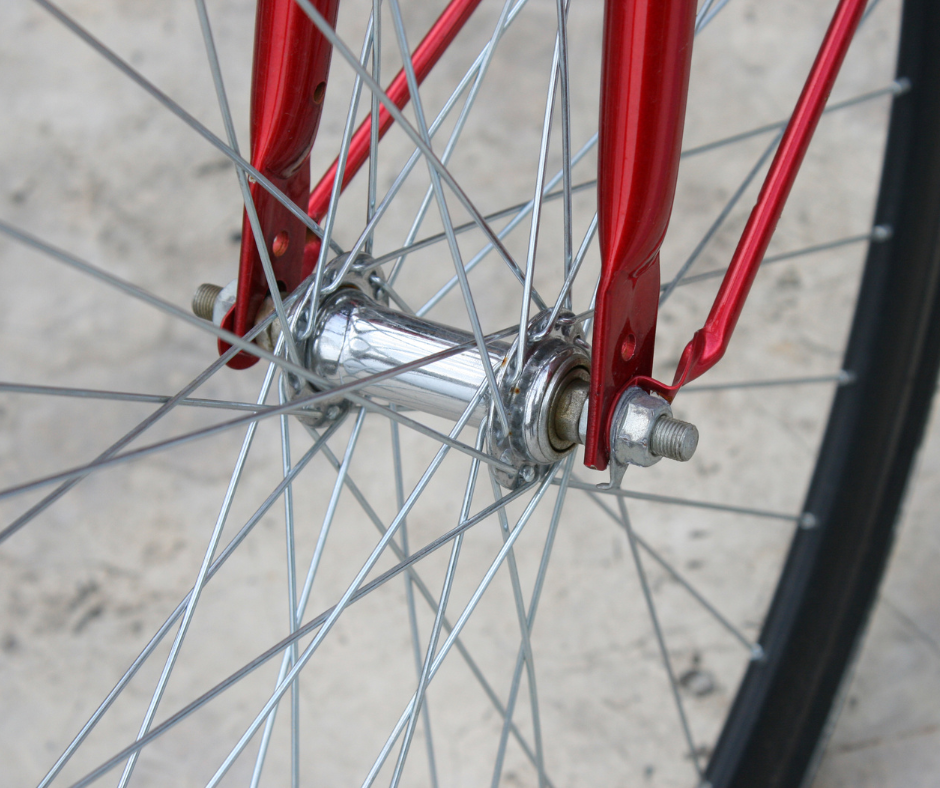
Here, I think of the word “true” like a bicycle wheel. Have you ever turned your bike upside down and spun the wheel to watch how it turns? If it is “true,” it turns smoothly, without wobbles, aligned with the central axis. Just like this, the patient is expressing intimacy with her system. She’s got the metaphorical bike upside down. She’s not trying to get anywhere, but just in a pause, noticing where things were “out of true.” She is self-stabilizing.
Acupuncture makes space for this to occur naturally. It is great because acupuncture is gentle and seems passive (you just lie there and take a nap), but it is sneakily active. It creates conditions that allow optimal function simply arise and take over. Courage to tackle a huge problem can crop up overnight when you’re getting good acupuncture care.
It was the perfect set up for a treatment using specific extraordinary channels that relate with digestion of past content and orienting towards the future.
Why the Plan Doesn’t Matter (Yet) and How Helpful Tools Become Misused
What matters is not that she had a complete plan. What matters is that movement had begun, at precisely the right moment in both the seasonal cycle and her own life.
Modern tools meant to support mental health can unintentionally interfere with this process when they are used to override bodily knowing. Meditation can be used improperly to quiet a signal rather than listen to it. Therapy can be used improperly to reason oneself out of discomfort that is actually informative. They are amazing tools—just like acupuncture—but they need to be used in a supportive way.
Elisabeth Rochat de la Vallée, in her work on the emotions in Chinese medicine, is explicit on this point:
“We cannot be without emotions.”
She emphasizes that pathology arises not from feeling itself, but from distortion and excess — when emotional movement disrupts the regular circulation of qi that sustains life. In other words, emotion becomes problematic when it can no longer move.
Artificial Calm vs. True Regulation: Feeling Without Being Captured
Daoist philosophy draws a similar distinction. In the Zhuangzi, equanimity does not mean the absence of feeling, but the capacity not to be harmed by one’s reactions. As Burton Watson translates it, the realized person is one who “does not allow likes or dislikes to get in and do him harm.”
Feeling is not the problem. Losing flexibility is.
This returns us to a central question in health and healing: are our practices increasing our capacity to be with reality, or are they manufacturing artificial calm?
Artificial calm, over time, makes us sick.
True regulation emerges when the system is strong enough to feel, discern, and move. This is the work of Shaoyang into Jueyin (Gallbladder into Liver) right now on the calendar, and it is the set up for the handoff to the other channels as we move forward in the wheel of the year. So, this is why learning how to feel your feelings, rather than bypass them, is not indulgent. It is foundational to health.
*Thank you Tara Rado in Durham, NC, for brainstorming this topic!
--
Anne Shelton Crute, DAOM, LAc, is a Doctor of Acupuncture & Oriental Medicine, licensed acupuncturist, Chinese Polestar astrologer, author, and instructor. She is the founder of Ritual Health Acupuncture & Herbalism in Berkeley, California, and teaches both Chinese medicine and Chinese astrology, with particular emphasis on classical texts, emotional physiology, and seasonal timing.