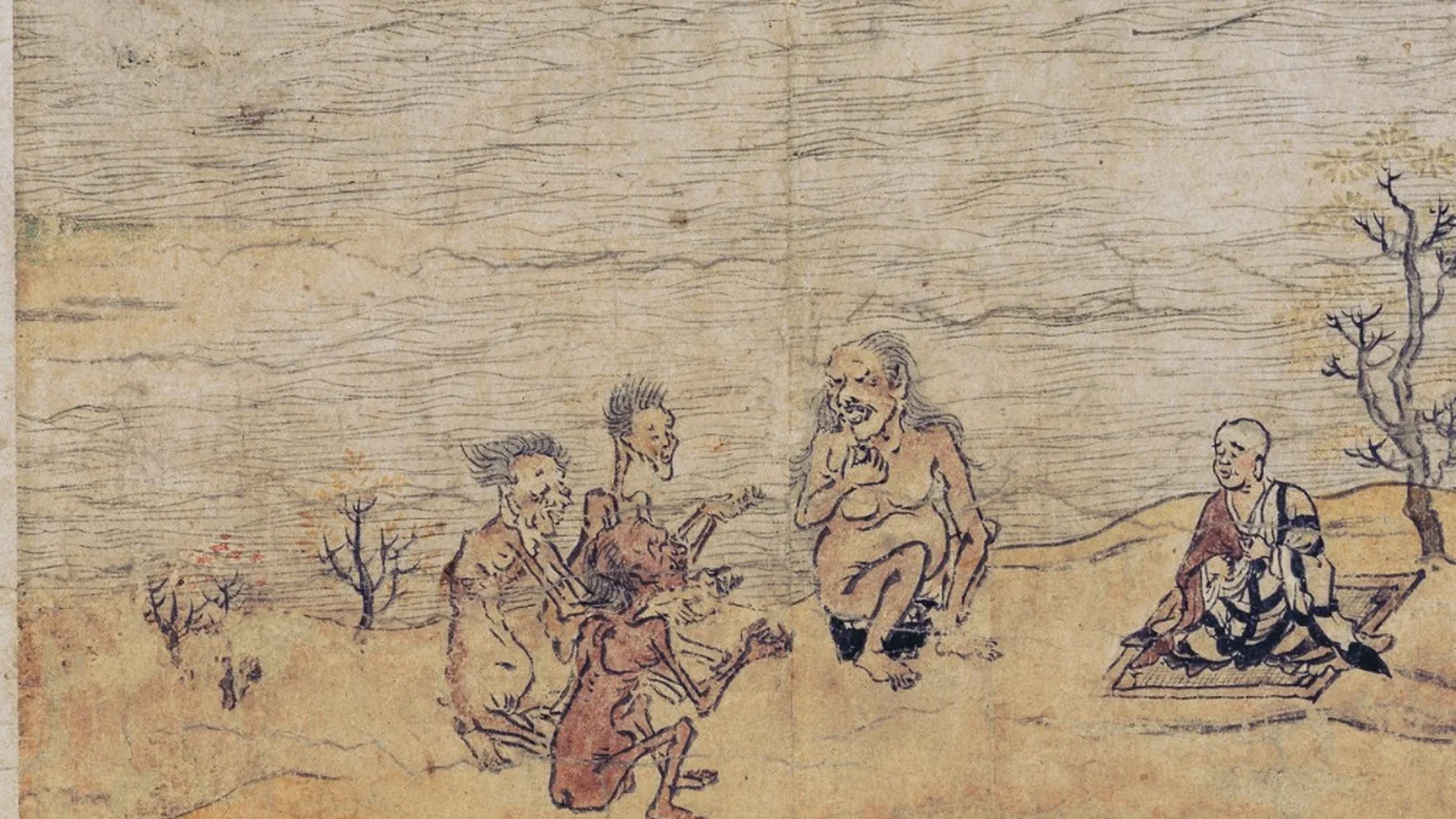
Hungry Ghosts Scroll (Gaki Zōshi), late 12th century, Japan. Anonymous, ink and color on paper. Kyoto National Museum. Public domain.
It’s Ghost Month.
The seventh lunar month is traditionally understood as a time when the dead are nearer to us than usual. The gates are open, hungry and wandering ghosts are about, and on the fifteenth lunar day, the Ghost Festival, we feed them.
This makes a lot of sense if we situate Ghost Month within the movement of the year.
The traditional Chinese calendar is organized around the movement of yin and yang through the seasons. The 24 solar qi nodes track this movement much more precisely than our ordinary contemporary four-season calendar does. Yang begins its return in the depths of winter, rises and expands through spring, and reaches its fullest outward expression in summer. Then the direction changes. Yang begins to retract and yin begins to return.
The Beginning of Autumn qi node arrives while it still feels very much like summer outside. This year it began on August 7. Obviously, the weather doesn’t suddenly become cold because the calendar says autumn has begun. Meteorology is local and follows its own particular conditions. What the calendar is tracking is the movement of qi underneath the weather. It is helpful to learn about both.
This distinction—learning to perceive the seasonal qi rather than simply observing the weather—is central to the way we work in Yangsheng class.
Fundamentally, at this time of year, yang is going away.
Early autumn is an interesting threshold because yang has begun to retract, but the yin that will eventually characterize the colder and darker half of the year has not fully arrived to occupy the space it leaves behind. It is traditionally described as a door opening.
This is when the world of the dead draw near. So, tradition says to acknowledge it.
I don’t mean this as a historical explanation for the development of Ghost Month. Rather, the traditional observance makes profound sense within the cosmology of the calendar. We have passed the great outward expansion of the year. Yang is withdrawing; yin is gathering. For a time, there is an opening between those movements, and the boundaries seem a little less solid.
So, we feed the ghosts.
Not Just Your Ancestors
Ghost Month is sometimes described as though it were simply another occasion for ancestor worship. Our ancestors are certainly part of it, but they aren't the whole story.
Of course, tend your ancestors. If you have an ancestral altar, clean it. Offer water, maybe food, and pay a little extra attention to your own dead. Particularly acknowledge those who seem neglected, hungry, wandering, troubled, or insufficiently tended.
I want to point to the fact that Ghost Month asks us to consider beings beyond our own families.
This is a time for those who have no one tending them: people who died far from home, people who died in war, those who died suddenly or violently, people who have been forgotten, people whose descendants are gone. We can consider those who may be confused about what has happened to them, the wandering dead, the hungry ghosts.
There is something important in this part of the practice. We don't have to determine who deserves to eat.
We don't need to know who they are or what their story was. We don't need to decide whether they were good people or bad people, whether they belong to us, or whether we have some special spiritual connection with them. We aren't trying to identify every possible recipient of the offering.
Something is hungry. We have food. We can feed. That's enough.
And Then Mind Your Own Business
One of my teachers used to give very simple instructions about this: put out some food, think of it nourishing whoever needs it, and then walk away.
Don't look back.
I really love this part. Don't fascinate. Don't check whether the food moved. Don't wait around to see if you feel something. Don't ask for a sign or try to figure out who came. Don't turn an act of generosity into a paranormal experiment or another interesting experience for yourself.
You made an offering. Let it be complete.
By the way, if you do have a sense of a ghost hanging around, you can be helpful without making an enormous thing out of it. You don't have to take on a new occupation as an exorcist, and there is no particular reason to identify with the experience.
The teaching as it was given to me is that this is simply part of our humanity. If someone is knocking, it isn't necessarily special and it isn't necessarily about you. Be polite. Keep your boundaries. Don't take on what isn't yours, but be generally helpful.
The conversation can be surprisingly ordinary: Hey, you're dead. That's okay. You don't actually have to be here anymore. It's okay to be dead. Here's some water. Bye, now.
The point is simply that it is time to acknowledge something that seems confused or stuck. Recognize that it can let go and continue into whatever comes next in the unfolding of its own essential nature.
By the way, Ghost Month is also not an invitation to cultivate psychic sensitivity so that we can see ghosts. Classical Chinese medicine has, in various contexts, regarded frequent or disturbing perceptions of ghosts as something that can accompany illness or imbalance. We don't need to settle the metaphysics of that statement here. It is enough to know that seeing ghosts all the time is not necessarily the fruit of attainment, nor is this sensitivity something we need to strive for. If experiences like this are frequent, new, or distressing, taking care of your own qi and shen is a reasonable first step. A regular old acupuncture treatment may be enough. If you actually need an exorcist, that's another matter; qualified professionals exist, they really do. (Not me.)
Some people do seem to have a particular aptitude for working with the dead. That's separate.
For most of us, the teaching is much simpler. The non-living are sometimes near. We can be helpful without making this our full-time occupation. There is no need to fear the dead, and there is also no need to become fascinated with them or over-engage them.
Feed them, especially at the appropriate times. Don't try to save them. Be business-like about it, and then go about your day.
The Hungry Ghost Part Is Also About Us
It is relatively easy to recognize that a ghost has already lived. Whatever remains unresolved, the life itself is complete. There is no more life to squeeze out of it. The kind thing is not to help the ghost remain indefinitely in the world of the living, but to feed what is hungry, help what is confused, and allow what has ended to be over.
This is worth considering in our own lives, especially now.
Autumn requires severance. Yang is retracting and yin is growing. The expansive phase of the year is ending, and the open space left behind is not necessarily a problem to solve. In fact, our ability to tolerate that space may tell us quite a lot about how well we are moving with the season.
Where are we allowing things to complete themselves? Where are we keeping something open because conclusion makes us anxious?
Perhaps we have made a decision but continue to behave as though every possibility must remain available. Perhaps a project has run its course, a relationship has changed its form, or an idea we had for the year simply did not become what we imagined. Sometimes we keep generating activity around something because the space that follows completion feels stranger than the activity itself.
By this point in the year, we know quite a lot about what actually grew. There is still plenty of work to do—harvest is work—but we are no longer in the generative movement of spring. We don't need to continually initiate. We need to tend what is here, bring things to maturity, gather what is useful, and permit appropriate endings.
If that movement feels unusually difficult, that is useful information. In Chinese medicine we are always interested in the channels: the physical channels through which qi moves, but also, in a broader sense, the habitual pathways of our minds and lives. What happens when the movement is supposed to turn inward and we continue insisting outward? What happens when yin is asking to gather and we keep spending yang?
Sometimes this is something we can practice quite consciously: leave a little space unfilled. Allow a decision to eliminate other possibilities. Finish something without immediately replacing it. Notice the impulse to reopen what has already concluded.
Sometimes the difficulty is deeper than an idea. This is one of the places where acupuncture can be particularly useful. We don't always need another story about why we can't let go. Sometimes we need help getting underneath the story, allowing the body to experience the seasonal movement directly: yang releasing, yin arriving, the channels reorganizing around a different direction.
Sometimes we simply needed someone to tell us that this movement is available to us now.
Ghost Festival gives us a small ritual opportunity to practice it. We feed what is hungry. We help what is lingering to continue. We don't require anything in return, and we don't keep the encounter open.
When you make your offering, you might let whatever can be complete, be complete. Then leave some space behind.
A Simple Ghost Festival Offering
Tend your own dead first. If you keep an ancestral altar, clean it, refresh the water, and make whatever offerings are customary for you. Incense is basic level and a great place to start for daily offerings. Water is great, too. (Don't drink it afterwards. When you clean it the next day, give that water to plant friends outside.)
Prepare a separate offering for the wandering dead. A little good food and water is enough. Pop a stick of incense on it for good measure, if you like. This is for whoever needs feeding—not only your ancestors, and not only spirits you know or prefer.
Place it outside in an appropriate liminal place. An edge, a roadside, or similar in-between place is traditional. Use common sense about animals, neighbors, traffic, and where you live. Use only biodegradable offerings.
Offer it without discrimination. You can remember those who died far from home, in war or disaster; those who died suddenly; the forgotten and untended; those without descendants; the confused and wandering. Then let the offering extend beyond anyone you can name: May whoever is hungry be fed. May whatever can be complete, be complete.
Walk away. Don't check. Don't look for signs. Don't wonder who took what. Don't turn around.
Let there be some open space.
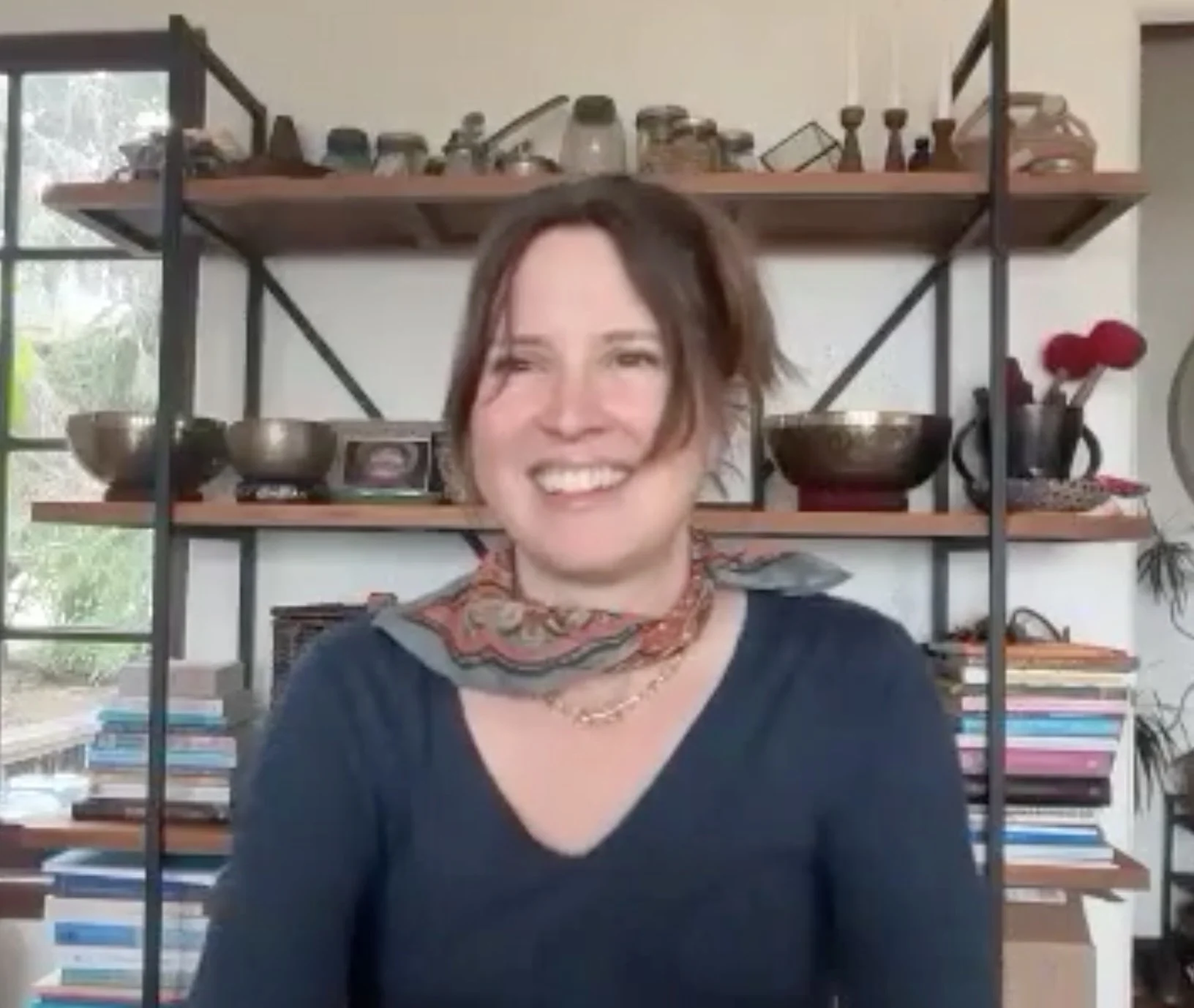
Dr. Anne Shelton Crute, L.Ac., DAOM is a licensed acupuncturist, herbalist, and teacher of classical Chinese medicine and traditional Chinese cosmology. She is the co-founder of Ritual Health Acupuncture & Herbalism in Berkeley, California, where she maintains a clinical practice in acupuncture and herbal medicine and teaches Yangsheng, seasonal cultivation, and Chinese Polestar Astrology. Her work is concerned with the practical application of traditional medicine and cosmology to ordinary human life.