

Ming Dynasty Woodcut of the Heart Channel, 1537
Shen is Not the Heart-Mind: Why This Distorts Classical Chinese Medicine
Anne Shelton Crute, Lac, DAOM
“When shen is present, life flourishes; when shen departs, life ends.”
— Huangdi Neijing, Suwen, chapter 8 (Larre & Rochat de la Vallée)
There is a line that appears frequently in modern writing on Chinese medicine: shen is the heart-mind.
The phrase sounds reasonable and even helpful. It gestures toward something real. In classical terms, however, it is an imprecise summary that subtly distorts the structure of the tradition. The issue is not that the phrase is entirely wrong. The issue is what it flattens, redirects, and recenters.
This essay explores why defining shen as heart-mind feels inaccurate from a classical perspective, what is lost when that shorthand is adopted, and how early Chinese medicine understood the relationship between the Heart, shen, and consciousness in a fundamentally different way.
The Problem with “Heart-Mind”
The phrase heart-mind immediately pulls interpretation toward interiority. It suggests an internal psychological state composed of thoughts, emotions, and subjective experience. Even when used carefully, the term tends to orient the reader toward modern ideas of mind and self.
Classical Chinese medicine does not begin from interiority. It begins from relationship.
When shen is defined as heart-mind, several shifts happen almost automatically. The Heart becomes over-centralized. Other spirit aspects such as hun, po, yi, and zhi recede in importance. Shen begins to resemble cognition or affect. Classical language describing governing, housing (because it is said that the shen resides in the heart—which is classically accurate but only partly true), and manifestation is quietly reinterpreted as identity.
The result is a modern psychological map laid over a system that was never constructed to describe internal mental states in isolation.
Shen Was Never Just Psychological
In pre-Qin sources, shen was not a psychological category. It referred to what was numinous, responsive, and transformative. Shen named the capacity of life to respond without deliberation and to transform without visible mechanism. It described aliveness itself rather than mental activity.
In this early usage, shen was not localized in an organ. It was not equivalent to cognition, emotion, or intention. The heart, xin, was responsible for thinking, deciding, and orienting. Shen manifested through life as a whole. Equating shen with mind in this context would have been a category error.
The Han Medical Shift
With the medical literature of the Han dynasty—this is AFTER the period just discussed—especially the Huangdi Neijing, shen becomes clinically relevant. The Suwen and Lingshu describe shen as something that can be observed. It appears in the eyes, speech, posture, and responsiveness of a person. It plays a central role in prognosis. It is said to be housed by the Heart.
Housing, however, does not imply identity. The Neijing repeatedly distinguishes between what stores and what governs. The Heart houses shen and governs the blood and vessels, yet shen manifests through the whole organism. This relationship is often expressed through political metaphors. The Heart is the ruler’s residence. Shen is the ruling presence. (By the way, all this use of military and political chain-of-command language is because of the impact of Legalism, a group of Warring States-period political theories, which impacted the writing in the Han. It is useful and not to be discarded, but I’m just asking us to remember what was important before them.)
In this framework, the Heart provides blood, rhythm, and coherence so that shen can manifest. Shen remains larger than any single organ, function, or mental faculty. It is not an internal mental state. It is the visible coherence of life.
One way that Liu Ming used to speak about shen was in relation to whether a person is conscious in the most literal sense: alive and awake, or not. Are they dead? Are they in a coma? Shen. In this view, shen is not about what one is thinking or feeling. It is about whether the light of life is present.
He also described shen as the aspect that recognizes what is true. He asked us to imagine unexpectedly seeing someone you know in an airport. Before thought and before emotion, there is a flash of recognition. Something rises up and meets what is familiar. Shen meets shen. That moment is not exactly emotional, although it is not devoid of feeling. It is vitality recognizing vitality. It is responsiveness prior to interpretation. Shen.
Ze’v Rosenberg comments that shen is not about thought and thoughts and mentation: that’s yi, the spirit of the spleen. It’s also not about passions, emotions, our inspiration-level body: that’s hun, the spirit of the liver. Shen is transcendent of these. “You can’t put a quality on it. It is very central axis of consciousness.”
This way of speaking aligns closely with early descriptions of shen in the Neijing as responsiveness, presence, and coherence rather than mental or emotional content.
Why “Internal State” Misses the Point
The strong association between shen and mental clarity develops much later. During the Song dynasty, Confucian thinkers such as Zhu Xi placed increasing emphasis on moral cultivation, clarity of awareness, and self-regulation. In dialogue with Buddhist ideas of mind and awakening, the concept of “heart-mind” became the primary site of ethical refinement for some practitioners, or a site of integration of an energetic/kriya practice.
Within this philosophical climate, shen began to be associated more strongly with luminosity, purity, and clear awareness. Very Buddhist. That’s fine, but it is important to recognize the influences affecting concepts as they transformed. Over time, awareness gradually became equated with mind. Mind gradually became equated with identity. See how it slides? This development was meaningful and influential, yet it also narrowed the scope of the term, an ironic contradiction.
Instead of reading shen as a cosmological mediator, it was increasingly read as an internal state.
Describing shen as an internal state introduces a framework that does not belong to classical Chinese medicine. The early medical worldview is relational rather than interior. It is structured around Heaven and Earth, form and formlessness, inside and outside, order and chaos.
One way to understand shen’s central role in this worldview is as mediation. The Neijing situates human life at the meeting point of Heaven and Earth, where destiny, ming, and vitality, qi, are integrated into living form.
Shen allows this integration to remain coherent.
When shen is reduced to heart-mind, that mediating axis disappears. The system collapses inward. What was once relational becomes psychological.
Clinical Consequences of Reduction
What I just wrote in the last section is the most important part, but for the doctors in the room, I want to cover the impact of this thinking on our patients and ourselves.
This shift has clinical consequences. When shen is treated primarily as a mental or emotional category, emotional disturbance is often labeled simply as shen disturbance. The composite role of the five spirit aspects is overlooked. Treatment strategies focus on calming the mind rather than restoring systemic coherence.
In classical terms, emotional and behavioral disturbances rarely belong to the Heart alone. They involve the movement and vision of the hun, the embodiment and sensation of the po, the meaning-making capacity of the yi, and the endurance and will of the zhi. Shen coordinates these functions. It does not replace them.
If modern language must be used, a closer formulation would be the following. Shen is the luminous vitality that allows life to be awake, responsive, and coherent. It is housed by the Heart and expressed through consciousness, although it cannot be reduced to mind or psychology. It is fundamentally the cosmological mediator: linking heaven (tian) and earth (di) in us (ren).
More simply stated, the Heart does not equal shen. The Heart enables shen to appear.
Much of the flattening of shen is amplified by the modern category of TCM. What is often taught under this name emphasizes protocol, standardization, and organ-centered psychology. This approach can be clinically effective, yet it represents only one historical layer of a much older tradition.
Earlier forms of Chinese medicine are messier, more animist, and more cosmological. Shen belongs to that older world. Discover it. That’s where true healing is.
Saying that shen is the heart-mind functions as a teaching shortcut. Shortcuts, however, shape understanding. When shen is reduced to mind, its most important role is lost: its function as the living mediator between Heaven, Earth, and the human being.
Allowing shen to remain larger keeps the classical system intact and leaves room for many streams of understanding. It preserves the vitality the term was meant to name.
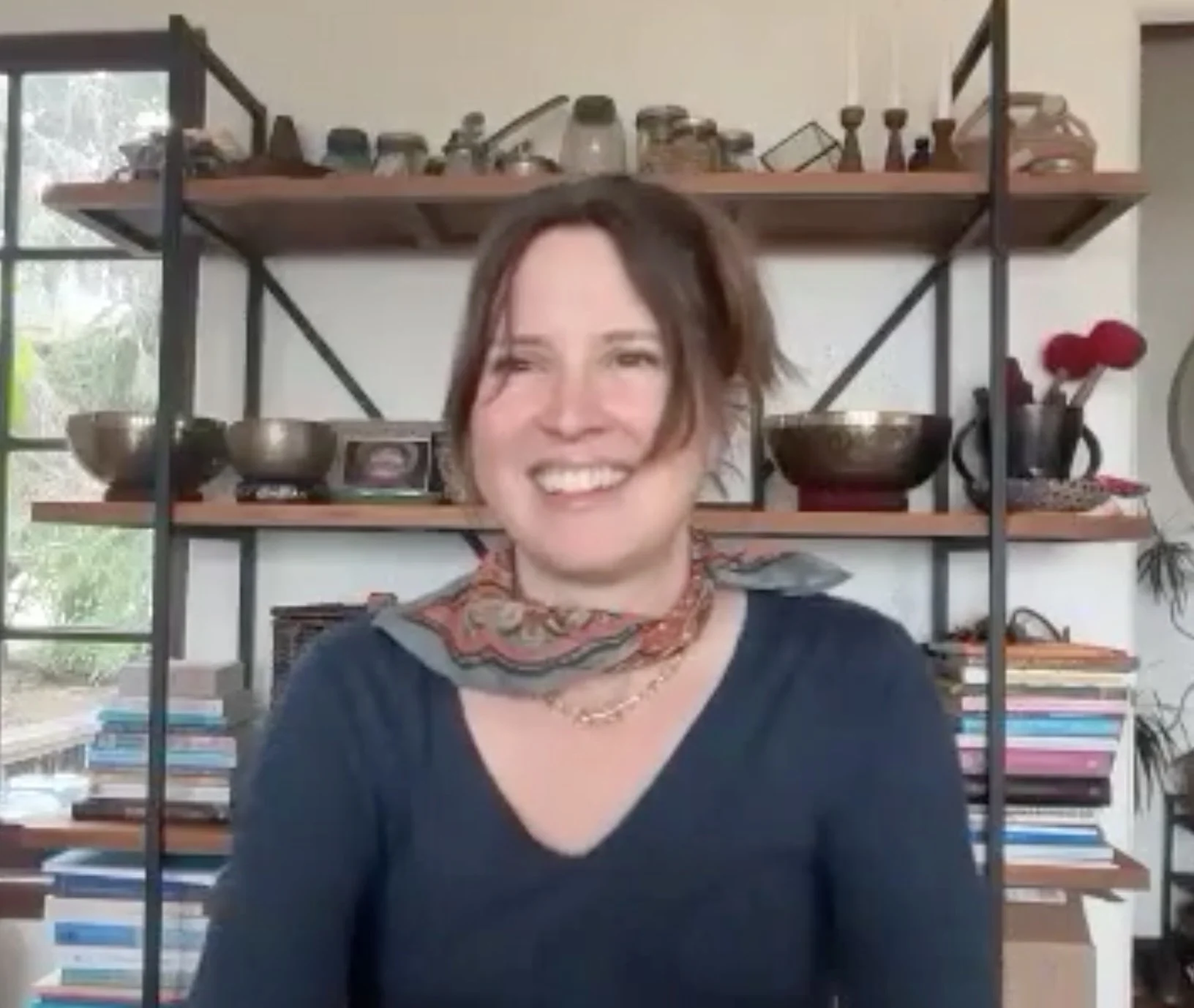
Anne Shelton Crute, DAOM, LAc, is a Doctor of Acupuncture & Oriental Medicine, licensed acupuncturist, Chinese Polestar astrologer, author, and instructor. She is the founder of Ritual Health Acupuncture & Herbalism in Berkeley, California, and teaches both Chinese medicine and Chinese astrology, with particular emphasis on classical texts, emotional physiology, and seasonal timing.