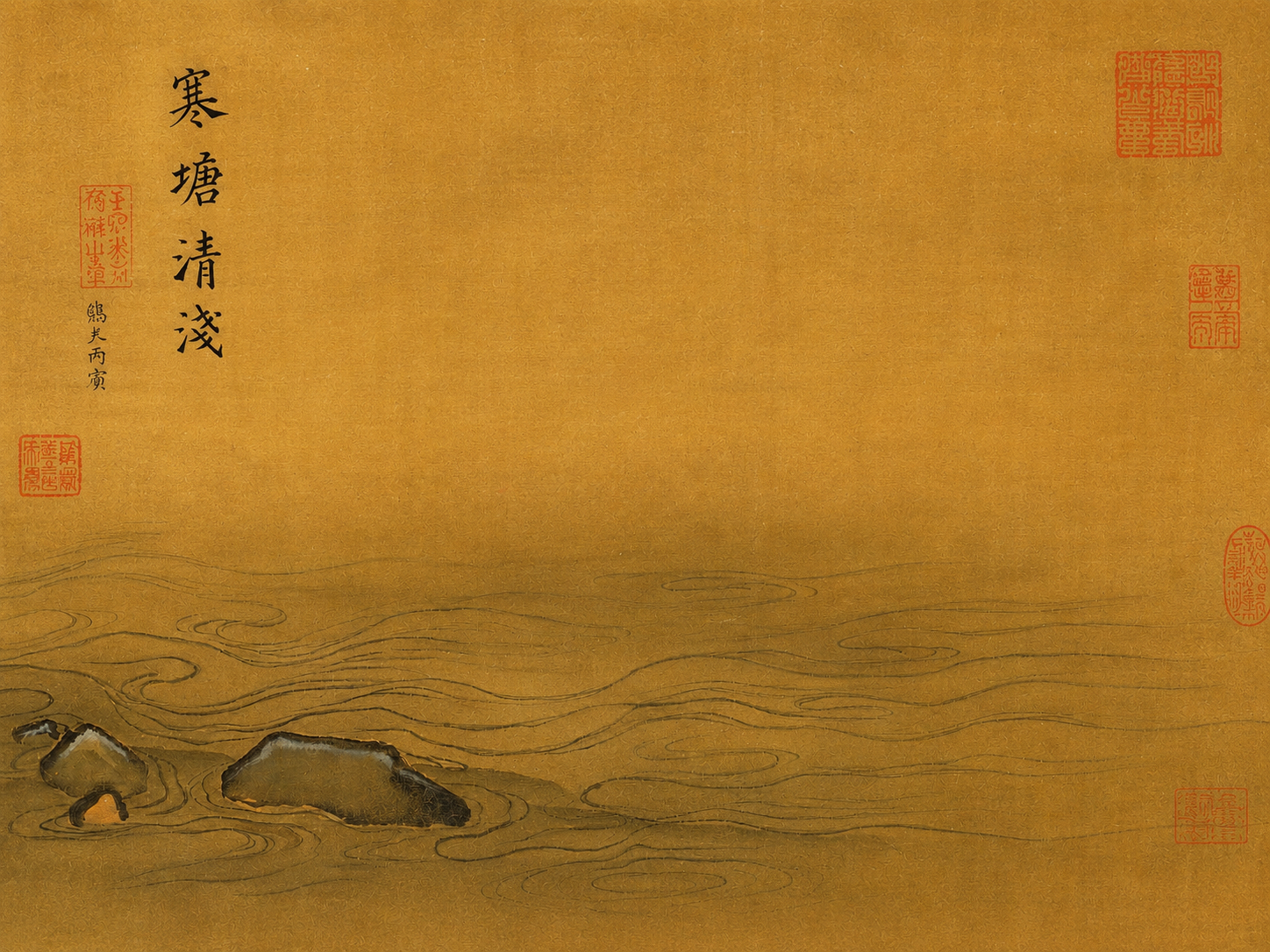
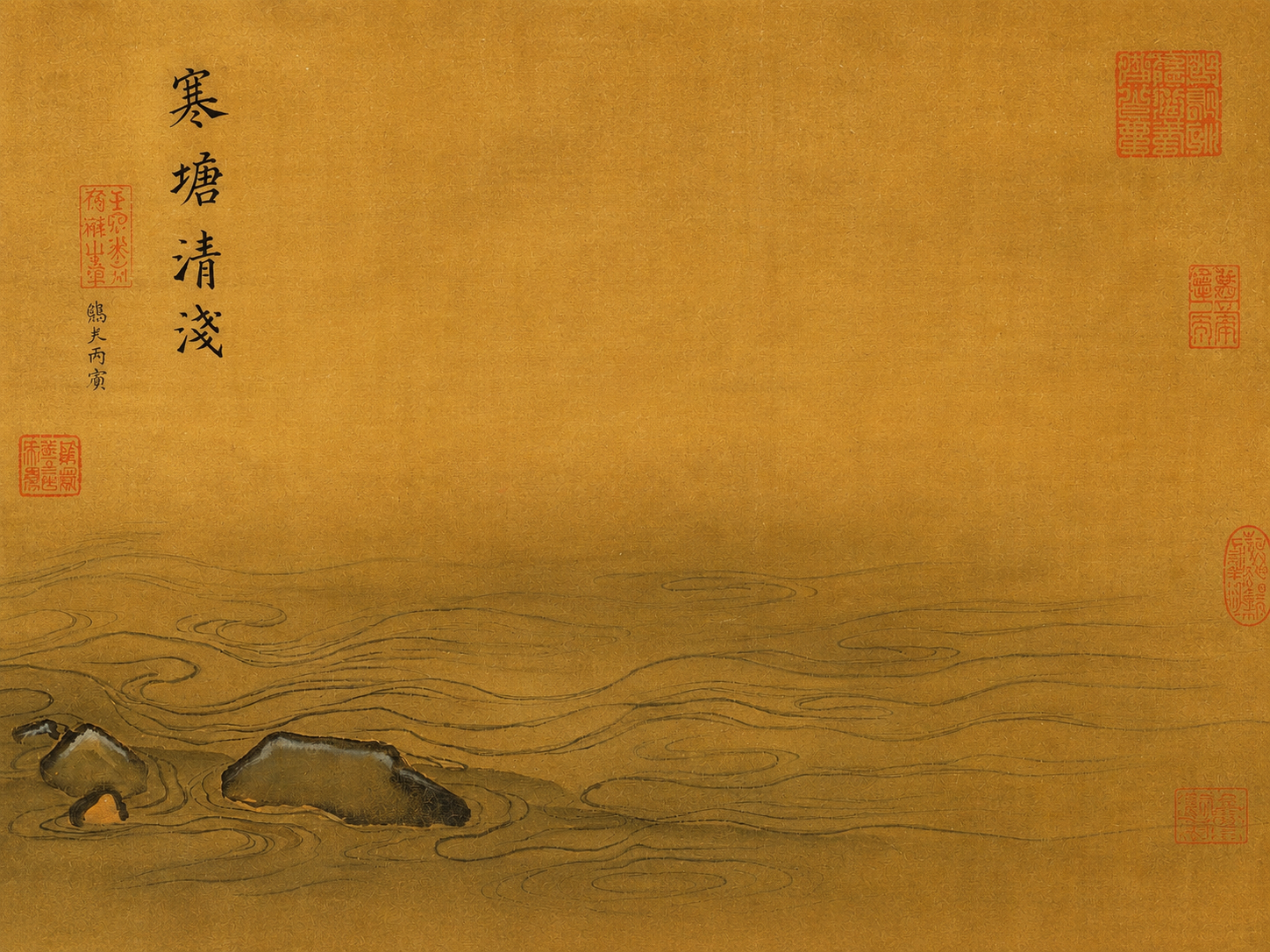
Ma Yuan, Cold Pond, Clear and Shallow, from the Water Album, c. 1222, Southern Song dynasty. Palace Museum, Beijing. Public domain.
Qing (清): The Medicine of Clarity
One of the most beautiful concepts in Chinese medicine is qīng (清).
It is usually translated as clear, pure, or clean, but none of these English words quite capture its meaning. In English, the word pure often carries moral overtones. We imagine purity as the opposite of contamination, goodness opposed to badness, or even spiritual worthiness. Those ideas have shaped much of Western thought, but they are not quite what the Chinese medical tradition is pointing toward.
In Chinese medicine, qing is not a moral quality. It is a functional one.
Nothing about you is inherently impure. Your body is not a problem to overcome, nor are your desires or emotions signs that you have somehow fallen from grace. Rather, the body is understood as a living landscape whose rivers, streams, and pathways can become obstructed over time.
Just as a creek can become clogged with fallen branches or a pond can become stagnant when water no longer moves, our physiology can lose its natural clarity. Fluids become thick. Heat becomes trapped. Digestion becomes burdened. The senses become dull. Our thoughts feel heavier, and our emotional lives can become more reactive or difficult to navigate.
The goal is not purification. The goal is restoring clarity.
Clarity Is a Physiological State
Chinese medicine describes the body as constantly performing an elegant act of discernment, separating clear from turbid and maintaining their appropriate movement.
“Clear yang forms Heaven; turbid yin forms Earth.”
—Huangdi Neijing Suwen, ch. 5
This pattern repeats itself throughout the body. In digestion, nourishment is separated from waste. In fluid metabolism, the clear is distributed while the turbid is eliminated. Qi circulates through the channels while what has become stagnant is moved on.
It is a story of discernment happening in the viscera every bit as much as it is happening in the mind. Different organ systems participate in different aspects of this process. The Spleen, Stomach, and Small Intestine separate and transform. The Lung and San Jiao disseminate qi and fluids. The Liver and Large Intestine keep movement continuous, preventing congestion and ensuring that what is no longer needed is released.
When this process functions well, there is ease. Digestion is efficient. Fluids circulate freely. The senses remain clear. We respond to situations rather than merely reacting to them.
When this movement is compromised, congestion, heaviness, sluggishness, dampness, phlegm, mental fog, and emotional reactivity begin to appear.
Clarity is not simply a mental experience. It is a moving, changing embodied state.
Cultivating Qing
If qing is a functional quality rather than a moral one, then it follows that clarity can be cultivated.
One of the most direct ways we do this is through what we eat. Foods that support qing are not defined by a fixed list of ingredients so much as by the relationship between the food, the person, and the season. Think about what you put into your body in terms of what activities it asks the body to perform. Have you offered the body a dietary load that requires an enormous amount of sorting through muck? Or have you offered gentle reinforcement to the body’s elegant and intelligent integration with nature?
What I would call a “qing diet,” then, is useful shorthand for a clarifying diet: one that supports the body's ongoing work of separating the clear from the turbid without unnecessarily burdening that process.
What does that look like in practice?
Generally, we begin with foods that are fresh, seasonal, and relatively uncomplicated. They leave us feeling nourished without feeling burdened. They support movement rather than stagnation, clarity rather than heaviness.
But qing is not a fixed diet. What supports clarity changes according to the season, the environment, and the person.
In the heat of summer, the body is working continuously to regulate temperature and replenish fluids. Foods such as cucumbers, melons, peaches, tomatoes, tender greens, lightly cooked vegetables, simple soups, rice, and other cooked grains help support that work without adding unnecessary burden. We are looking for foods that lightly clear heat while maintaining stable energy and substance.
In the cold of winter, the body's task is different. Warm broths, miso soup, slow-cooked stews, root vegetables, beans, whole grains, and other gently warming foods help conserve warmth and nourish more deeply. Though these meals are richer than those of summer, they can still support qing because they are appropriate to what the body is being asked to do.
Just as importantly, we avoid making the body work harder than necessary. In summer, that often means limiting heavy fried foods, excessive cheese, or meals that are overwhelmingly raw and cold, such as an enormous salad or a container of yogurt standing in for a proper meal. In winter, the challenge is often excess rather than cold: too many rich foods layered together, oversized meals, or eating continuously without giving digestion time to complete its work. In every season, the question is the same: Does this meal support the work the body is already doing, or does it compete with it?
This is one of the hallmarks of Chinese medicine. It is remarkably free of absolutes. There are no universally “good” foods or “bad” foods. The question is always one of relationship: What season is it? What is this person's constitution? What demands are being placed upon them? What is the body trying to accomplish?
Cultivating qing is not about eating perfectly. It is about learning to reduce unnecessary burden so that the body's own capacity for discernment can do its work.
Why Clarity Matters
Food, however, is only the beginning.
Everything we take in asks something of us. The conversations we have, the media we consume, the environments we inhabit, the pace at which we live, and even the quality of our sleep all become part of what the body and mind must continually digest. Some experiences become nourishment. Others become congestion.
From a Chinese perspective, health is not merely the absence of symptoms. It is also the capacity to meet the world as it actually is.
When our physiology is relatively clear, our senses are less clouded by internal congestion. Our perception changes. We become more available to the present moment. We notice subtle changes in ourselves, in other people, in the weather, and in the environment around us. We are less occupied by the body’s internal effort to manage congestion and more available to what is happening before us.
Many of the great cultivation traditions describe this as becoming more responsive to time: recognizing the season we are in, understanding the circumstances before us, and discerning the most appropriate response for this particular moment. Appropriateness does not arise from rigid rules. It arises from seeing clearly.
Clarity does not remove complexity but allows us to participate in it more skillfully.
We become less driven by habit, compulsion, or reactivity. Decisions often require no greater intelligence than before, only fewer internal obstructions. The clearer the physiology, the freer the mind, the less interference between what is happening and our ability to respond to it. Our observations sharpen and our wisdom becomes more grounded, but not because we possess special knowledge, but because we are listening with fewer obscurations.
Qing allows us to perceive relationship more faithfully. We recognize the season, the landscape, the people before us, and our own condition not as separate pieces of information but as aspects of a single unfolding moment. From that recognition, appropriate action arises naturally.
Living with Qing
As clarity returns, the world begins to appear differently.
Landscape, weather, physiology, emotion, dreams, and circumstance are no longer experienced as separate domains requiring separate explanations. They become different expressions of one living reality. We are no longer standing apart from the world trying to understand it. We discover that we have always been participating.
From this perspective, conduct is not primarily about self-discipline or moral virtue. It is the form participation takes. What we eat, how we sleep, the work we undertake, the conversations we enter, and the forms of attention we cultivate all shape that participation. They are not isolated lifestyle choices, but expressions of how we inhabit the world.
When that relationship is obscured, perception fragments. We begin treating every symptom, every emotion, every decision, every dream, and every circumstance as independent problems to solve. We compensate by collecting rules, techniques, and explanations, each addressing one small piece while the larger pattern disappears from view. As unnecessary burden falls away, perception begins to gather itself again.
Intuition is what perception feels like when perception is no longer fragmented.
It is not a mysterious faculty or an extraordinary gift. It is what becomes possible when our participation in life is no longer divided against itself. A place is no longer simply a location. The changing season is no longer merely weather. Even dreams are no longer divorced from waking life. The world is encountered less as a collection of separate events and more as the living reality in which we participate.
Qing does not remove us from the complexity of being human. It restores the clarity that allows us to participate in the world as it is.
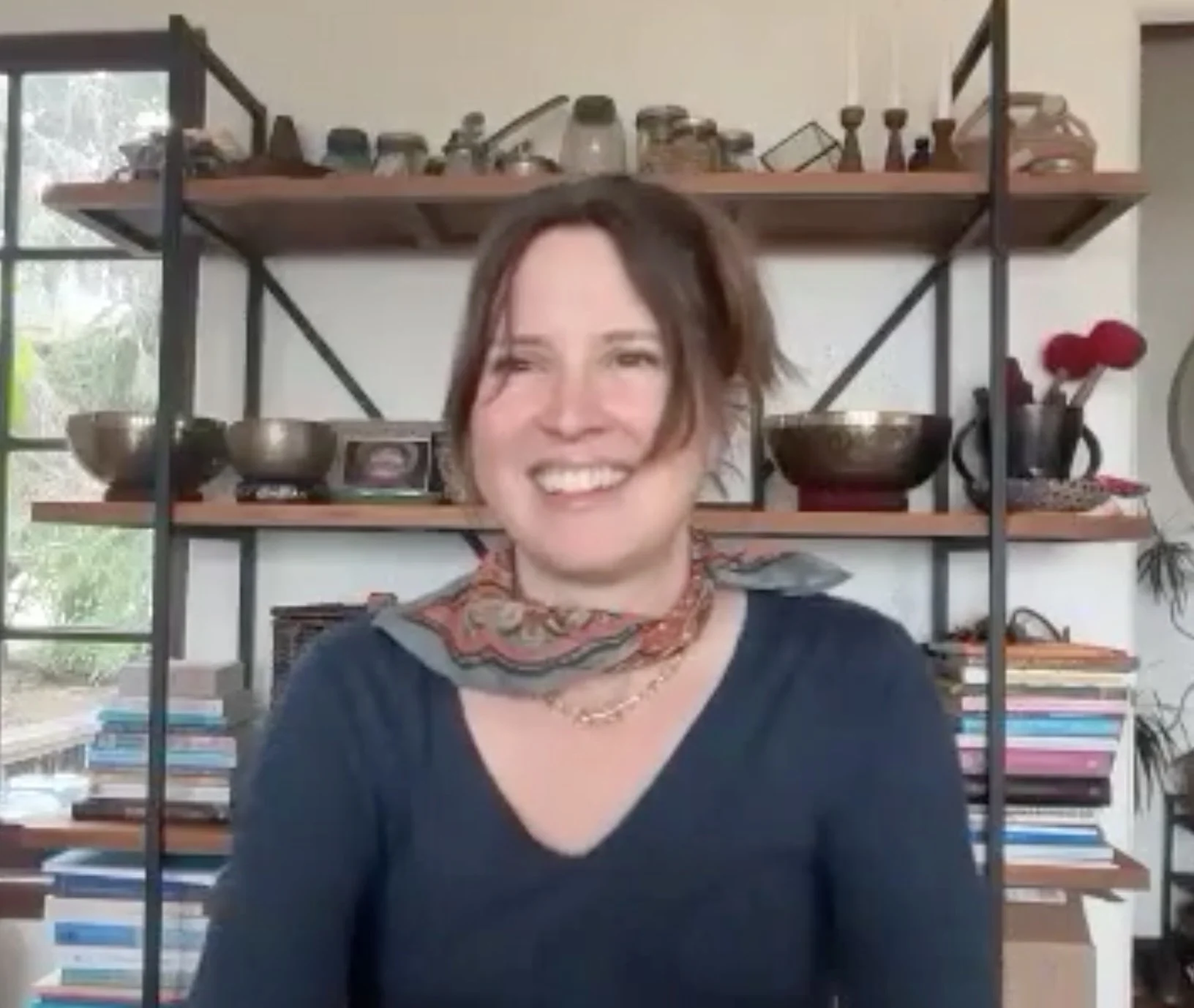
Anne Shelton Crute, LAc, Dipl.OM, DAOM, is a Doctor of Acupuncture and Oriental Medicine and founder of Ritual Health Acupuncture & Herbalism in Berkeley, CA. A clinician, writer, and educator, her work is rooted in classical Chinese medicine and explores the relationships among medicine, cosmology, seasonal cultivation, and the ways we understand and participate in health.